
Cybersecurity
Cybersecurity Built to Stop Real Attacks — Not Just Check a Box.
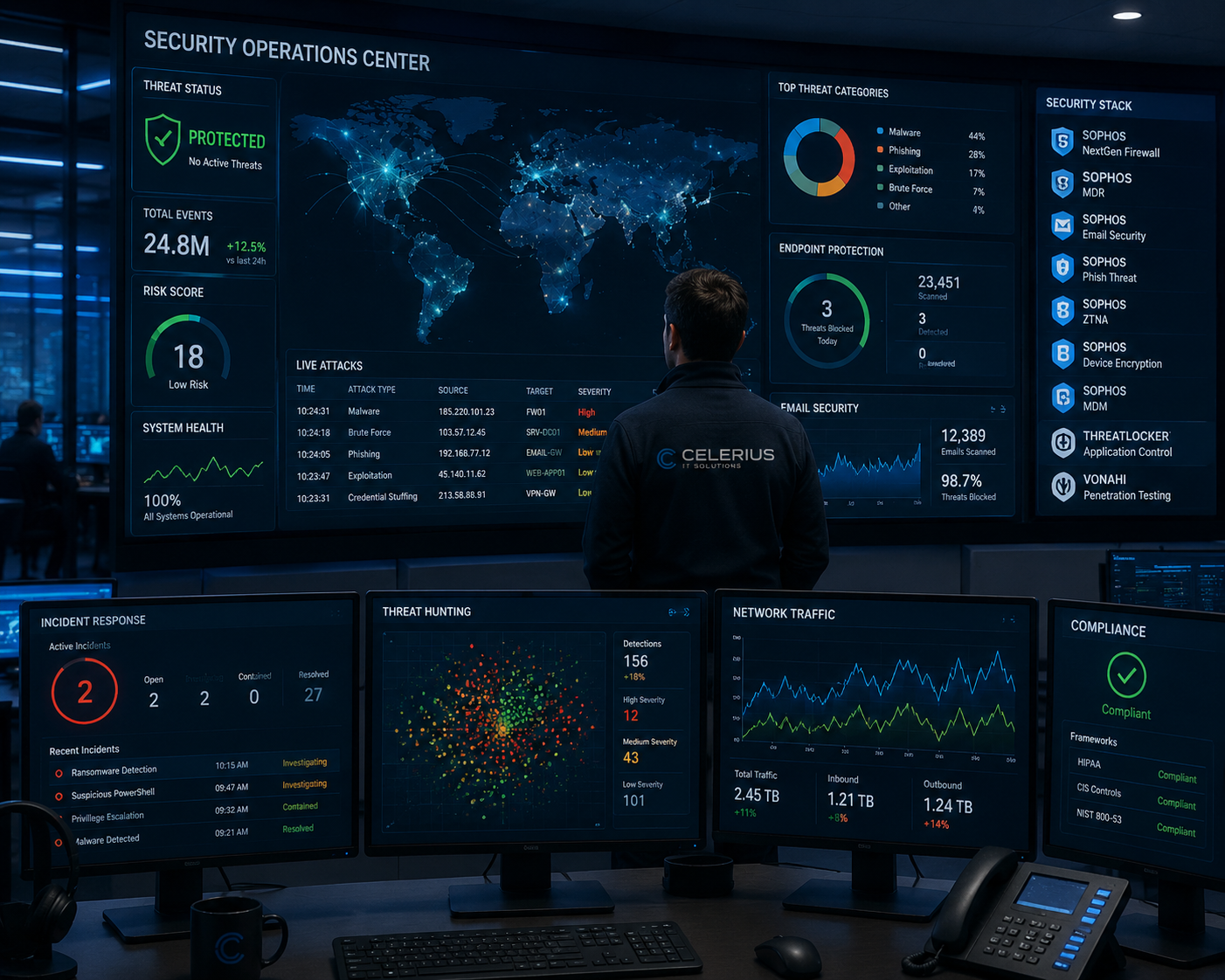
Most providers install antivirus and call it security. Celerius builds cybersecurity as a layered defense model across your network, endpoints, email, users, applications, remote access, and ongoing validation.
Risk Awareness
Most businesses do not realize they are exposed until after the damage is done.
Email compromise, ransomware, stolen credentials, unmanaged devices, and unauthorized software often start quietly. The goal is to reduce the chance of compromise, detect suspicious activity quickly, and limit what an attacker can do if they get in.
The Celerius Approach
Security works best when every layer reinforces the next.
A single tool cannot stop every threat. We combine firewall protection, monitored endpoints, email defense, user training, encryption, mobile controls, zero trust access, application allowlisting, and penetration testing into one security operating model.
What this means for your business
- Reduce ransomware and business interruption risk
- Protect users, devices, email, and remote access
- Detect suspicious activity faster with human-led monitoring
- Limit what attackers can run, access, or move through
- Validate defenses with recurring penetration testing
Security Layers
A practical security architecture for SMB and mid-market environments.
We do not position cybersecurity as one product. We organize it into defensive layers that are easier for leadership to understand and stronger for attackers to get through.
Network Protection
Sophos NextGen Firewall / SFOS
Controls the edge of the network with firewall policy, intrusion prevention, web protection, VPN/ZTNA integration, threat filtering, and traffic visibility.
Business value: helps block malicious traffic before it reaches users and systems.
Endpoint Detection & Response
Sophos MDR Complete or Essentials
Provides managed threat detection, investigation, and response across endpoints so security alerts are reviewed in context instead of ignored as noise.
Business value: suspicious behavior is investigated by security experts, not left sitting in a console.
Data Protection
Sophos Device Encryption
Protects data on laptops and workstations with full-disk encryption, reducing exposure if a device is lost, stolen, or removed from the office.
Business value: protects sensitive business data even when the hardware is no longer in your control.
Email & Phishing Defense
Sophos Email Security Advanced + Sophos Phish Threat
Filters malicious email, suspicious links, impersonation attempts, and risky attachments while helping users recognize phishing attempts through training.
Business value: reduces the most common entry point for ransomware, credential theft, and fraud.
Zero Trust Remote Access
Sophos ZTNA
Replaces broad network exposure with controlled access to specific applications based on user identity, device posture, and business need.
Business value: remote users get access to what they need without exposing the entire network.
Mobile Device Security
Sophos Mobile Device Manager
Manages mobile devices, security posture, policies, and access controls for organizations where phones and tablets touch business data.
Business value: mobile devices become managed business assets instead of unmanaged risk.
Application Control
ThreatLocker
Uses allowlisting and application control to prevent unauthorized software from running, including unknown tools, scripts, and attacker-launched utilities.
Business value: if software is not approved, it does not run.
Security Validation
Vonahi Security Penetration Testing
Tests the environment from an attacker’s perspective to uncover exploitable gaps, weak configurations, and paths that need remediation.
Business value: you do not have to assume you are protected — you can validate it.
Security Validation Proof
Find the vulnerabilities before attackers do.
Automated penetration testing powered by Vonahi gives your business more than a vulnerability scan. It simulates real attacker behavior, validates exploitable paths, and turns the results into executive-ready reporting, technical evidence, and a prioritized remediation plan.
Sample assessment impact
What the test validates
- Exploitable vulnerabilities across your network
- Weak configurations and insecure protocols
- Password, identity, and access control weaknesses
- Lateral movement paths attackers could use
What leadership receives
- Executive-level risk summary
- Severity-ranked findings
- Business impact explanation
- Clear remediation priorities
What technical teams receive
- Technical evidence and affected systems
- MITRE ATT&CK mappings and attack narrative
- Validation details and reproduction context
- Remediation guidance tied to findings
Proof You Can Review
See what your report could look like.
These sample reports show how penetration test results are translated for both business leaders and technical teams. The executive summary focuses on risk, severity, and remediation direction. The technical report provides the deeper evidence needed to fix the root causes.
Executive Summary Sample
High-level business summary with engagement statistics, risk categories, finding severity, and remediation priorities.
View Executive SummaryTechnical Report Sample
Detailed technical report with discovered threats, affected systems, evidence, recommendations, and attack narrative.
View Technical ReportFrom Findings to Fixes
We do not stop at identifying risk.
Celerius helps turn penetration test findings into prioritized remediation work: patching gaps, security baseline improvements, firewall and egress filtering controls, insecure protocol cleanup, and practical next steps your business can act on.
If Something Gets Through
Real cybersecurity includes response.
Prevention matters, but response is what limits damage. With MDR, endpoint isolation, access controls, and operational visibility, Celerius helps identify, contain, and remediate threats faster.
Attack Path Defense
We map security controls to the way attacks actually unfold.
A real attack does not respect product categories. It moves from email to identity, endpoint, application execution, lateral movement, and data exposure. The stack is designed to interrupt that path at multiple points.
Typical Attack Path
Celerius Defense Layers
What You Are Protected Against
Security stated in business terms, not tool names.
Ransomware
Reduce the ability for malicious software and attacker tools to execute, spread, or encrypt business data.
Phishing & BEC
Filter malicious email, train users, and reduce credential theft and invoice fraud risk.
Unauthorized Access
Limit remote access with Zero Trust controls and device posture requirements.
Lost or Stolen Devices
Protect sensitive information with device encryption and mobile policy management.
Unknown Software
Block unapproved applications, scripts, and utilities before they become a security incident.
Security Blind Spots
Use penetration testing to identify weaknesses before attackers find them.
Why It Matters
Basic IT security is not enough for today’s threat landscape.
| Basic MSP Security | Celerius Cybersecurity Approach |
|---|---|
| Antivirus installed and monitored reactively | MDR-backed endpoint protection with investigation and response |
| Traditional VPN access to the network | Zero Trust access to specific applications based on user and device posture |
| Email filtering with little user conditioning | Email Security Advanced plus phishing simulation and training |
| Users can run most applications by default | ThreatLocker allowlisting blocks unapproved software execution |
| Security assumed unless something breaks | Penetration testing validates controls and exposes gaps |
Operational Visibility
Security signals should not live in disconnected tools.
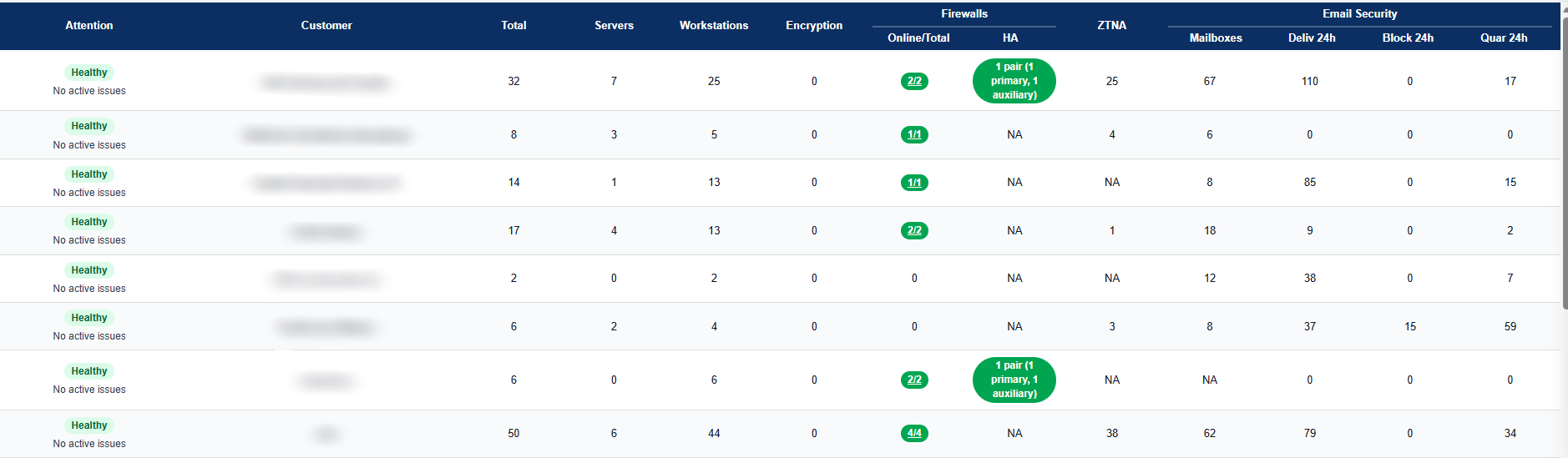
Celerius views cybersecurity as part of how IT is operated. Firewall status, endpoint posture, alerts, access, and infrastructure health are evaluated together so risk is easier to see and act on.
 View full image
Security + Lead Generation Engine
A security page built to educate, qualify, and convert.
This page now connects the technical security stack to business risk, proof, and a clear next step: a practical security assessment that helps leadership understand where the environment is exposed.
Ransomware Readiness
Shows how email, endpoint, application control, access, backups, monitoring, and testing work together to reduce ransomware exposure.
Executive Clarity
Explains risk in business language so owners and leadership can make decisions without needing to decode security tooling.
Assessment Conversion
Directs prospects toward a low-friction security assessment instead of a vague “contact us” request.
Security Assessment Offer
Find your highest-risk gaps before they become an incident.
Celerius reviews the practical areas attackers commonly exploit: email security, endpoint protection, firewall posture, remote access, identity controls, backups, application execution, and security visibility.
Best use: send this page after discovery calls, use it in follow-up emails, and connect paid traffic to the dedicated assessment page.
Why Celerius Is Different
Find the gaps before an attacker does.
Layered, not single-tool
Security is organized across network, endpoint, email, access, applications, mobile devices, and validation.
Human-led detection
MDR adds investigation and response instead of relying only on automated alerts.
Validated protection
Penetration testing helps confirm where controls are working and where gaps need attention.