How We Operate

Structured IT operations. Security built in from day one.

Celerius operates your environment through a proactive, security-first model designed to reduce disruption, strengthen protection, and give leadership better visibility into technology risk.

The Celerius Operating Model

We do not just respond to tickets. We operate the environment.

Most IT providers focus on fixing problems after users are already affected. Our approach is built around visibility, standardization, monitoring, security, and continuous improvement.

The goal is simple: fewer surprises, faster resolution, stronger security, and better business outcomes.

Structured ProcessEvery engagement follows a documented operating model instead of ad-hoc support.
Security Built InEndpoint, network, identity, cloud, and access decisions are made through a risk-reduction lens.
Operational VisibilitySystems, firewalls, WAN, cloud, backup, and security signals are monitored for clearer action.
Business GuidanceLeadership gets planning conversations around priorities, lifecycle needs, risk, and budget.

5-Pillar Model

Our proven framework for stable, secure IT.

Every engagement follows a structured operating model so your environment is not managed by guesswork.

1Discover & Assess
2Stabilize & Standardize
3Secure & Protect
4Monitor & Maintain
5Optimize & Advise
01

Discover & Assess

We review your current environment, identify risks, document gaps, and establish a baseline for support, security, performance, and business continuity.

Outcome: You know exactly where you stand.

02

Stabilize & Standardize

We address immediate issues, clean up weak points, standardize systems, and align the environment to proven operational practices.

Outcome: A cleaner, more predictable IT foundation.

03

Secure & Protect

We build security into the environment through layered protection across endpoints, identity, networks, users, cloud services, and remote access.

Outcome: Reduced risk and stronger defense.

04

Monitor & Maintain

We use proactive monitoring, alerting, patching, maintenance, and operational visibility to detect issues earlier and resolve them faster.

Outcome: Problems are handled before they become disruptions.

05

Optimize & Advise

We review trends, plan lifecycle needs, improve performance, reduce risk, and help leadership make better technology decisions.

Outcome: IT becomes a strategic advantage.
Before & After

From frustrated and reactive to stable, secure, and confident.

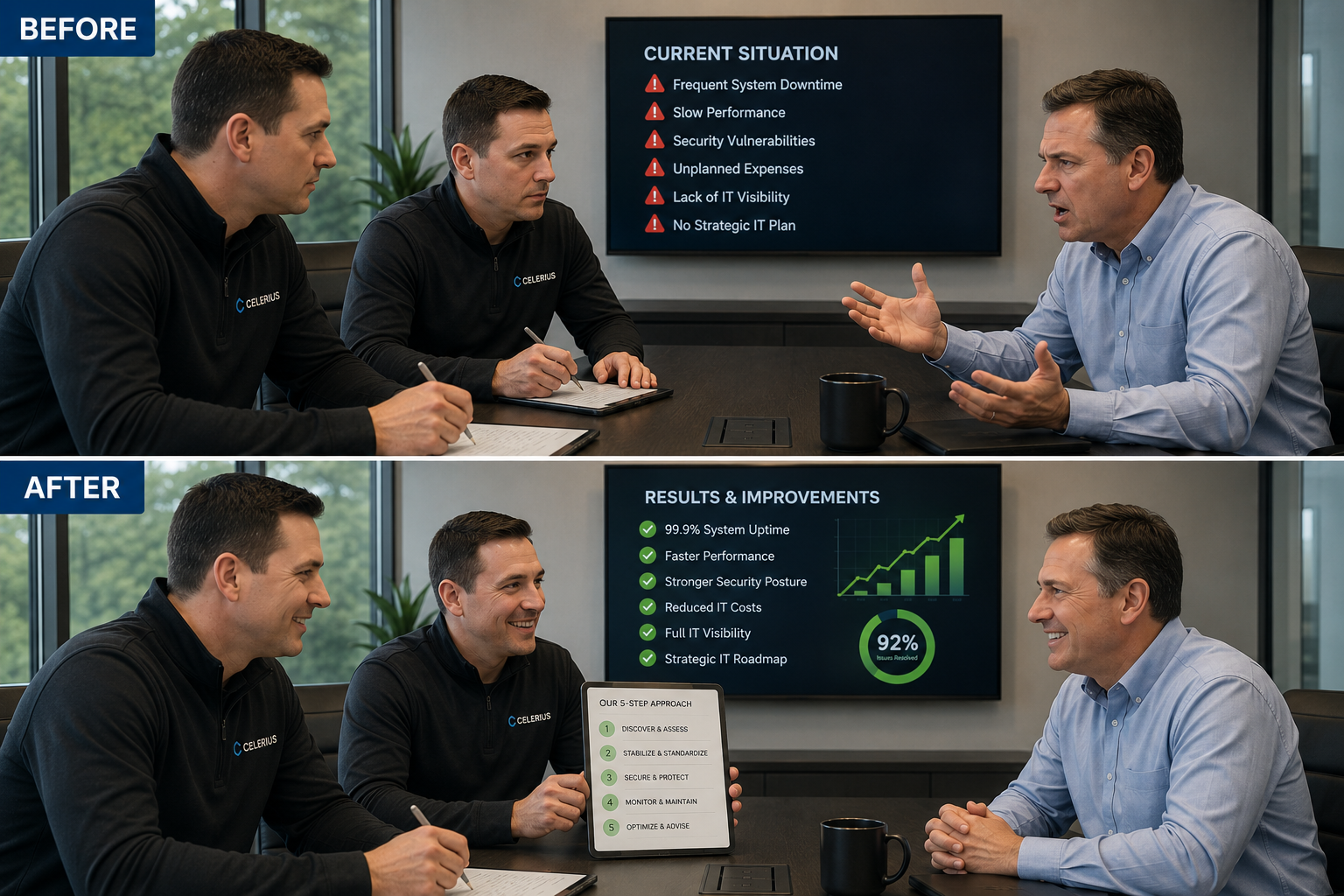
The Celerius operating model is designed to turn scattered IT problems into a structured improvement plan your leadership team can see and understand.

Before and after Celerius operating model meeting showing a frustrated customer before and a satisfied customer after results are presented.
Before: reactive IT, recurring issues, and limited visibility. | After: a cleaner, more secure environment with measurable improvement.
Fewer Recurring IssuesRoot-cause remediation instead of repeated ticket churn.
Better VisibilityMonitoring across systems, networks, security, and cloud services.
Stronger Security PostureLayered protection built into daily IT operations.

Why It Matters

Not all IT providers operate this way.

Typical IT Provider

  • Reactive ticket handling
  • Fixes issues after disruption
  • Limited visibility across systems
  • Security treated as an add-on
  • Little root-cause follow-through

The Celerius Approach

  • Proactive operational monitoring
  • Issues prevented, not just repaired
  • Visibility across endpoints, firewalls, WAN, cloud, and security tools
  • Security built into daily operations
  • Root-cause analysis to reduce repeat issues

Support Experience

What happens when your team needs help?

Support should feel organized, prioritized, and accountable. We do not just close tickets—we look for ways to prevent the same problems from coming back.

1Issue Detected

Automatically through monitoring or submitted by your team.

2Immediate Triage

Prioritized by urgency, impact, and business risk.

3Rapid Resolution

Resolved remotely whenever possible, with on-site support when needed.

4Root-Cause Follow-Through

Reviewed to reduce recurring issues and improve stability.

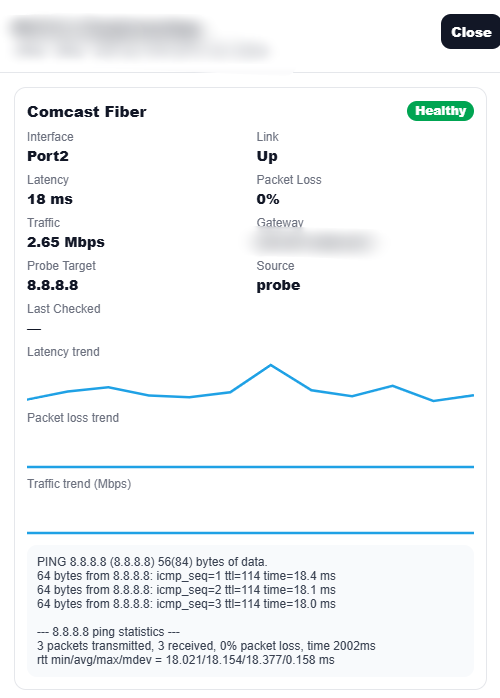
Celerius WAN health monitoring view showing latency, packet loss, WAN circuits, and firewall telemetry. View full image
Operational VisibilityWAN health, firewall telemetry, latency, packet loss, and circuit visibility help identify issues faster.

Visibility & Reporting

You should know what is happening in your environment.

  • Health and performance visibility
  • Security status and risk insights
  • Backup, endpoint, firewall, WAN, and cloud awareness
  • Strategic reviews and planning conversations

Onboarding

A controlled transition, not chaos.

Switching IT providers can feel risky. Our onboarding process is designed to reduce disruption while we gain visibility, stabilize the environment, and begin improving security.

Week 1–2

Discovery & Planning

Access review, environment discovery, documentation gathering, risk identification, and transition planning.

Week 2–4

Stabilization

Monitoring deployment, immediate issue cleanup, security baseline review, and standardization of key systems.

Month 2+

Optimization

Lifecycle planning, strategic improvements, cybersecurity alignment, reporting cadence, and continuous improvement.

Proof in Practice

Real-world examples of the Celerius operating model.

Different businesses have different pain points. The model stays consistent: assess, stabilize, secure, monitor, and continuously improve.

Operational Stability

Manufacturing Organization

Challenge: Recurring support issues, limited visibility into network health, and no clear way to understand risk across the environment.

What We Did: Assessed the environment, stabilized priority issues, standardized monitoring, improved security visibility, and created a proactive support process.

  • Reduced recurring issues through root-cause remediation
  • Improved visibility into system, network, and security health
  • Created a clearer path for budgeting, lifecycle planning, and risk reduction
Security Risk Reduction

Professional Services Organization

Challenge: Leadership needed greater confidence that systems, users, and remote access were being protected against modern cyber threats.

What We Did: Reviewed the security baseline, strengthened monitoring, improved endpoint and network protection, and aligned support with proactive risk reduction.

  • Security became part of day-to-day operations, not a separate afterthought
  • Issues were identified earlier before they could become larger problems
  • Leadership gained more confidence in system protection and support coverage
Planning & Visibility

Growing SMB Environment

Challenge: Technology decisions were being made reactively, creating budget surprises, aging infrastructure, and unclear priorities.

What We Did: Created operational visibility, reviewed lifecycle needs, identified risk areas, and helped leadership prioritize improvements.

  • Clearer roadmap for upgrades and lifecycle planning
  • Better alignment between IT investment and business needs
  • More predictable conversations around risk, budget, and priorities

Client Confidence

What clients value about working with Celerius.

“Just wanted to say how much we appreciate Celerius! They completely put our minds at ease with their round-the-clock support and proactive security, making tech issues a thing of the past. Their proactive monitoring caught issues before they became problems. We feel confident our systems are in safe hands.”

Office Manager Professional Services Organization

“Celerius has been an outstanding partner for our company. Their team brings a high level of professionalism, technical expertise, and responsiveness to every project. They understand our business needs and how important network reliability is.”

Controller Manufacturing Organization

Working With Us

What the relationship should feel like.

The right IT partner should reduce uncertainty. Our operating model is built around responsiveness, communication, accountability, and long-term improvement.

Clear communicationYou understand what is happening, what matters, and what comes next.
Proactive recommendationsWe look ahead instead of waiting for problems to interrupt the business.
Security-first guidanceSupport decisions are made with risk reduction in mind.
Business-aligned planningTechnology decisions are connected to growth, budget, compliance, and resilience.

Authority Through Execution

What makes the model stronger than a basic help desk.

The authority of this page is not just the process. It is the way the process connects support, security, reporting, lifecycle planning, and executive guidance into one operating rhythm.

Operational rhythmIssues, alerts, risks, and recurring patterns are reviewed through a consistent improvement process.
Security alignmentCybersecurity is reviewed alongside support activity, not treated as a separate conversation once a year.
Executive clarityLeadership gets plain-language visibility into what is healthy, what is exposed, and what should happen next.
Continuous improvementThe goal is not just ticket resolution. The goal is fewer repeats, stronger protection, and better decisions.

The Client Journey

From unknown risk to managed improvement.

This is the path we want a prospective client to understand before they even speak with us.

UncoverFind hidden gaps, recurring issues, and risk areas.
PrioritizeSeparate urgent needs from long-term improvements.
StabilizeClean up the issues creating disruption.
SecureStrengthen protection across users, systems, and access.
AdvanceMove into planning, optimization, and lifecycle strategy.

Ready for Better IT Operations?

See what this model would uncover in your environment.

Start with a Celerius assessment and get a clearer view of your risks, gaps, support needs, and security priorities.